

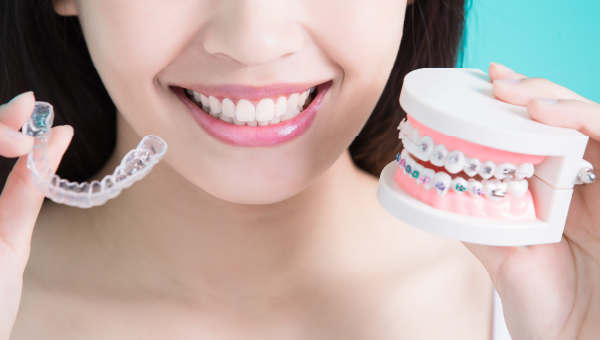
Are Clear Aligners as Effective as Traditional Braces?
Centra Dental
Clear aligners can be as effective as fixed braces for many mild-to-moderate orthodontic problems, but they are not equally predictable for every movement or every severe bite problem. An overview of 18 systematic reviews concluded that clear aligner therapy is effective for selected mild-to-moderate malocclusions, while fixed appliances still have advantages for some complex cases and specific tooth movements (Yassir et al., 2022).
For patients comparing clear aligners near me with traditional braces, the better question is which option can predictably deliver the movements your diagnosis requires– and Centra Dental is here to help.
Where Clear Aligners Perform Just as Well as Braces
In selected cases, comparative studies have found similar overall treatment-quality scores between clear aligners and fixed appliances, while patients often prefer aligners for appearance, removability, and day-to-day comfort. A 2024 systematic review concluded that aligners can be an effective alternative to conventional braces, although the evidence base still includes relatively small and heterogeneous studies (AlMogbel et al., 2024). For families considering clear aligners for teens, that means convenience does not automatically require sacrificing results - as long as the case is appropriate for aligners and the patient wears them as directed.
Where Traditional Braces Still Have an Edge
Traditional braces remain more predictable for some demanding movements and complex malocclusions because fixed brackets and wires allow continuous force and do not depend on the patient remembering to wear an appliance. Reviews have identified limitations for aligners in certain rotations, torque control, extrusion, and other complex movements, although technology continues to evolve (Yassir et al., 2022; AlMogbel et al., 2024).
Clear aligners also depend heavily on adherence: most systems require wear for most of the day, typically around 20 to 22 hours or as directed by the treating clinician. Repeatedly leaving trays out can delay progress or require refinements.
Comparing the Two Approaches at a Glance
| Factor | Clear Aligners | Traditional Braces |
|---|---|---|
| Mild-to-moderate cases | Often effective in selected cases | Often effective in selected cases |
| Complex bite corrections | Can be less predictable for some movements | Often provides stronger control for complex movements |
| Average treatment duration | May be shorter in selected cases; evidence is mixed | Varies by case and treatment mechanics |
| Comfort & aesthetics rating | Often preferred for removability and appearance | More visible and may cause bracket/wire irritation |
| Dependence on compliance | High because trays are removable | Lower because the appliance is fixed |
This comparison is a decision aid, not a promise that one appliance is universally better. Mild-to-moderate cases may be suitable for either approach, while complex bite correction, patient age, oral hygiene, esthetic preference, and willingness to wear removable trays can change the recommendation. The final choice should come after a clinical examination and treatment plan rather than being based only on convenience or appearance.
Why Treatment Time Often Differs Between the Two
Treatment-time research is more nuanced than the common claim that aligners are always faster. An overview of systematic reviews found conflicting results, although aligners may be associated with shorter treatment in selected mild-to-moderate cases (Yassir et al., 2022).
A later evidence review focused on mild-to-moderate crowding likewise found that treatment duration depends on case selection and study design rather than appliance type alone. Digital planning can make aligner treatment efficient, but refinements, missed wear time, or movements that do not track as planned can add visits and extend the timeline.
Clear Aligners for Teens: What Parents Should Know
Parents considering clear aligners for teens should focus on both diagnosis and responsibility. Because trays are removable, a teen has to wear them consistently, keep them clean, avoid losing them, and follow the schedule for changing trays.
Some aligner systems may offer wear indicators or digital monitoring, but these features are not universal and do not replace good habits. When a teen is unlikely to keep removable trays in for the prescribed hours, fixed braces can be more predictable simply because treatment is not dependent on daily wear decisions.
How Centra Dental Approaches This Decision
The clear aligners vs braces decision should be made after the bite and tooth movements are evaluated. At Centra Dental, the team can review crowding, spacing, bite relationships, age, oral hygiene, and the patient's ability to follow a removable-appliance schedule before recommending an approach. Centra Dental's clear aligner service is intended for appropriate children, teens, and adults, while traditional fixed braces remain available when they offer better control for the case. The most useful plan is the one that balances predictability, health, appearance, and the patient's ability to follow through.
If your case involves more significant crowding, challenging tooth movement, or a complex bite correction, it is worth reviewing Centra Dental's traditional braces page as well. Fixed appliances can still be the more predictable choice for certain orthodontic goals.
You can also browse the full range of dental services to see how orthodontic care fits into your broader treatment plan.
Are you looking for affordable clear aligners for yourself or your teen? Contact Centra Dental to schedule an evaluation and compare the options based on your actual bite, treatment goals, and budget.
Sources
Clinical Oral Investigations. "Clinical Effectiveness of Clear Aligner Treatment Compared to Fixed Appliance Treatment: An Overview of Systematic Reviews." 2022.
Journal of Orthodontic Science. "Efficacy of Clear Aligner Therapy Over Conventional Fixed Appliances in Controlling Orthodontic Movement: A Systematic Review." 2024.
Evidence-Based Dentistry. "In Mild to Moderate Crowded Cases, Is There a Difference in Orthodontic Treatment Duration Between Clear Aligners and Fixed Appliances?" 2024.
Journal of Pharmacy and Bioallied Sciences. "Patient Satisfaction with Clear Aligners vs. Traditional Braces: A Comparative Study." 2025.
